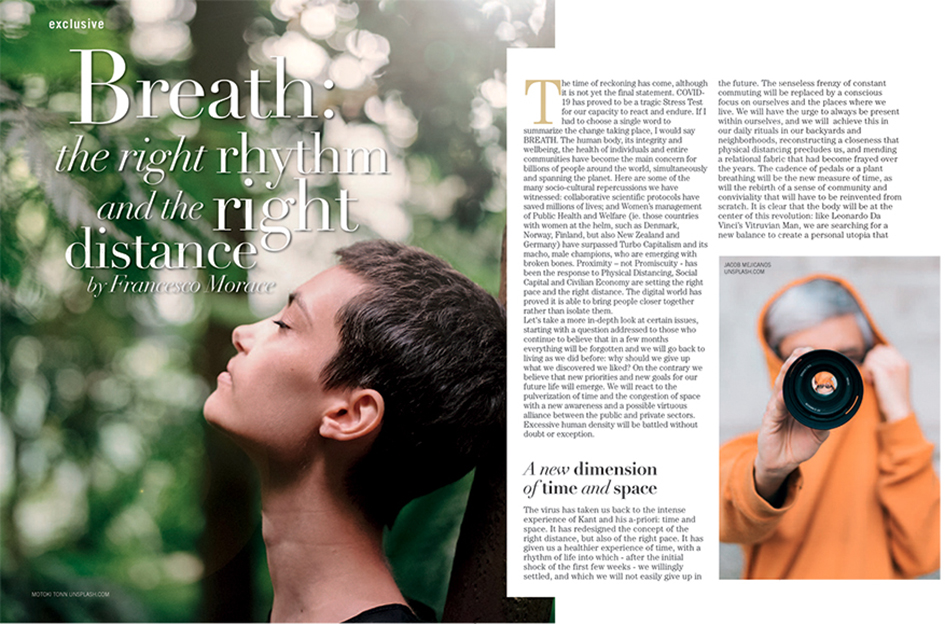
If I had to choose a single word to summarize the change taking place, I would say BREATH. The human body, its integrity and wellbeing, the health of individuals and entire communities have become the main concern for billions of people around the world, simultaneously and spanning the planet. Here are some of the many socio-cultural repercussions we have witnessed: collaborative scientific protocols have saved millions of lives; and Women’s management of Public Health and Welfare (ie. those countries with women at the helm, such as Denmark, Norway, Finland, but also New Zealand and Germany) have surpassed Turbo Capitalism and its macho, male champions, who are emerging with broken bones. Proximity – not Promiscuity – has been the response to Physical Distancing, Social Capital and Civilian Economy are setting the right pace and the right distance. The digital world has proved it is able to bring people closer together rather than isolate them. Let’s take a more in-depth look at certain issues, starting with a question addressed to those who continue to believe that in a few months everything will be forgotten and we will go back to living as we did before: why should we give up what we discovered we liked? On the contrary we believe that new priorities and new goals for our future life will emerge. We will react to the pulverization of time and the congestion of space with a new awareness and a possible virtuous alliance between the public and private sectors. Excessive human density will be battled without doubt or exception.


I am a heading
Get the latest issue of Intima!
I am a heading
A new dimension of time and space
The virus has taken us back to the intense experience of Kant and his a-priori: time and space. It has redesigned the concept of the right distance, but also of the right pace. It has given us a healthier experience of time, with a rhythm of life into which – after the initial shock of the first few weeks – we willingly settled, and which we will not easily give up in the future. The senseless frenzy of constant commuting will be replaced by a conscious focus on ourselves and the places where we live. We will have the urge to always be present within ourselves, and we will achieve this in our daily rituals in our backyards and neighborhoods, reconstructing a closeness that physical distancing precludes us, and mending a relational fabric that had become frayed over the years. The cadence of pedals or a plant breathing will be the new measure of time, as will the rebirth of a sense of community and conviviality that will have to be reinvented from scratch. It is clear that the body will be at the center of this revolution: like Leonardo Da Vinci’s Vitruvian Man, we are searching for a new balance to create a personal utopia that can only stem from a renewed awareness of our psychophysical wellbeing. It starts with health, not a fitness regime; from the pursuit for wellbeing that is not a performative religion or an extreme diet, but rather a new way of feeling good, of living in our bodies in a more conscious manner. In this research, clothing and fashion accessories resume their natural role, once again becoming bearers of wellbeing, comfort, beauty and protection. Moving on par with the research and experimenting of new forms and materials, to which technology and science can make an important contribution, we seek to allow the body to breathe. And again: BREATH. The first anti-Covid fabrics and yarns are already being researched, falling perfectly in line with the growing attention towards comfortable, anti-allergic materials and the all-round need for protection.
The symphony of the right distance
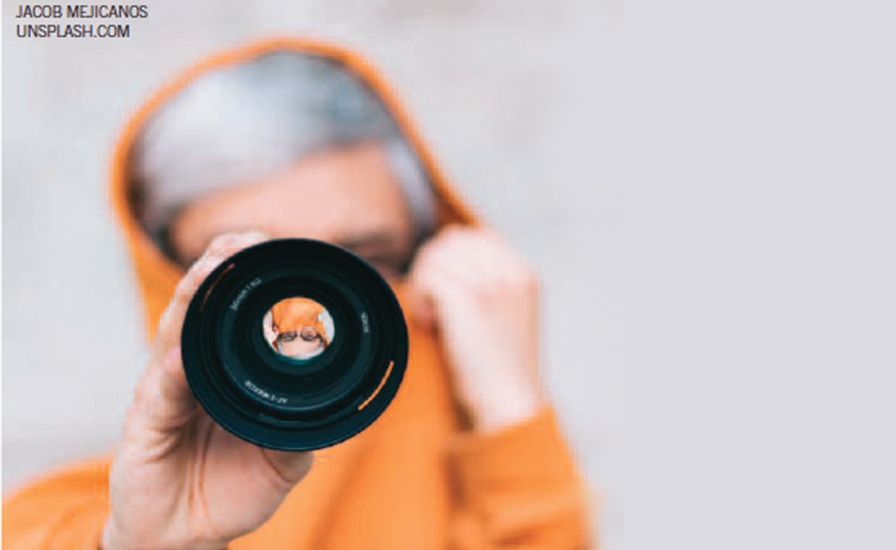
In addition to the right shape and the right pace, we are also learning which is the right distance. Good photographers learn quickly: the ideal distance is that which allows the subject to breathe. It is not the distance of a selfie, deforming faces and smiles. It is not the distance of a close-up. It is that distance which – by taking a step backwards – allows us to frame reality, to bring it into focus. The right distance of proximity, but not indiscriminate closeness. The right distance from things, which become useful when you learn how to handle them with care, with the measured gestures of a craftsman. The right distance from information, which, in order to become knowledge, requires reflection and comparison. The right distance from the digital, which risks becoming a whirlpool into which we fall, instead of being a well from which we extract buckets of wonder. The right distance from ourselves, from hypertrophic egos that risked becoming the cause of our ruin. The right distance that can also refer to our clothing, which for 90 days remained confined to a space of nonrepresentation, in close contact with a body and mind that were suffering severe discomfort. Clothing that had to be there for us alone: close to our body and its psycho-physical needs. For decades, we have been obsessed with visibility and resonance: being there at all costs, the terror of missing something, of not showing up on the right occasions. Today, COVID- 19 is teaching us that resonance must make room for consonance: playing with, being in tune, like those artists and musicians who offered their talent to us from their homes without expecting adoring crowds. This is the style that we will have to learn to recognize, even in how we dress.

The priceless charm of (new) normalcy
In closing, a reflection on the coming months: it is
normal to want what we have lost. It is therefore
not difficult to imagine what will happen. An
intense and growing desire for what we missed: the
hugs of relatives, the smiles of friends, the
closeness of colleagues and acquaintances. And
then the daily rituals, as simple as they are
essential: croissants and coffee at the local cafè, a
game of tennis with friends, walks in the park,
weekend trips away or to holiday homes (for those
who have one). The rites of shopping within limits:
accessories and clothing, jewelry and luxuries for
those who can afford them; even the celebration of
parties and birthdays that we have had to postpone.
A new normality that is all about daily time that we
failed to value enough before, when it seemed too
normal. This is the ‘halo’ effect of COVID-19, which,
like an alien spaceship, landed in our lives and
radicalized everything, every occasion.
A lesson in everything: at times such as these, we
need to value things, not maximize them; you can’t
put a price on that which is truly of worth. Such as
the health and wellbeing that was so violently
attacked by the virus, in both body and mind. At
this stage, companies need to value relationships
instead of maximizing profit. Value is nourished by
desire: we want what we don’t have, and this is how
we define Value. This is how we start this phase of
new normality, devoted to value. Creative minds
and designers will finally have the opportunity to do
what they have always dreamed of: close their eyes,
imagine the world as they would like it and draw
what they see. Renzo Piano did just that with the
new bridge in Genoa, which was built in record
time. Designers will have to create spaces,
environments, products and garments with the
focus on our new breathing space. This will allow us
to respond to social distancing with the mental
rapprochement of reciprocity: that which, for a few
weeks, finally led us to live as a community of
people united towards a common destiny.
Francesco Morace for Intima Media Group
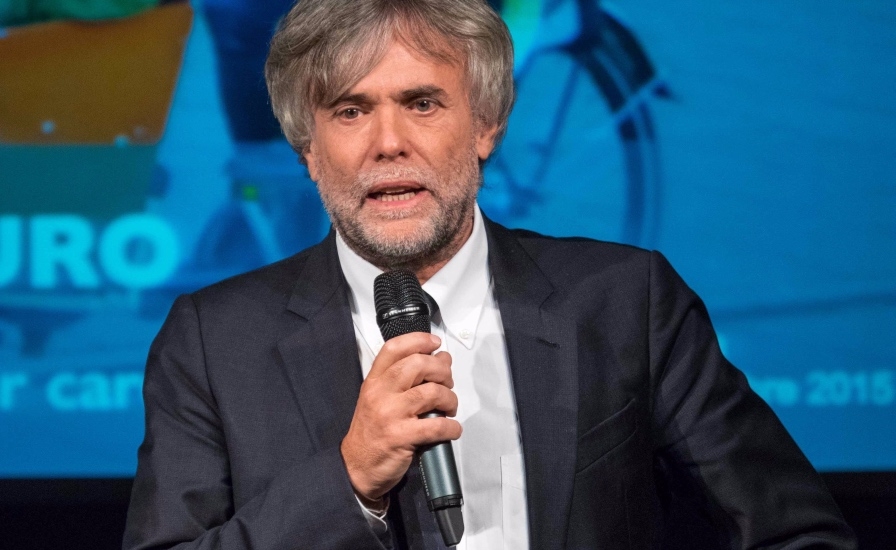
Francesco Morace – renowned sociologist and author
of over 20 published works, as well as the founder and President of
Future Concept Lab, and consultant for various international
institutions and enterprises – to give his insight into some of the new
realities that are soon to become part of our lives.